# Pachymeres (Basel, 1560)
##
expand\_more
Translated from the Greek by Enrico Prodi, University College London (2023)
**On George Pachymeres’compendium of Aristotle’s philosophy**
**and Philippus Bechius’ translation thereof into the Latin language,**
**improvised trimeters by Conrad Gessner.**
Everyone praises the man from Stagira \[*i.e.* Aristotle\] as wise,
As the most excellent of all, and the only one
To have set out methodically each part
Of the whole of philosophy, admirably and truthfully.
They bestow this honour on him first and last
Of men, making him – a mortal – into a god.
Yet, while they repute this the purest spring,
They turn elsewhere when they wish to drink,
For they say that the books of the man from Stagira
Are very many, long, and not written clearly,
Barely intelligible, only with difficulty
And a great deal of toil, so as to require the proverbial
Delian diver, or some kind of Oedipus.[\[1\]](/pachymeres-basel-1560#23)
But now they will no longer have any such excuse
Left to allege, since the illustrious George
Nicknamed Broad-Strokes \[*Pachymeres*\] has devised
A paraphrase and a compendium of the books
of the philosopher, brief and easy to grasp.
For he does not go into minute detail, nor does he proffer us
Over-clever talk woven out of abstruse chatter;
Instead, he declares the bare truth in broad strokes,
Teaching in rough outline what is more important.
Philosophy (he says) is rather like the sweet
Hellebore, which purges if taken
In large pieces, but when it is cut too finely,
It chokes him who drinks it and <it> brings no benefit.
So come, all you young men, buy
Pachymeres’ books and take profit from them
In your most noble passion for glorious wisdom.
Now they have been translated by Philippus Bechius
Into the fair language of the Latins;
In character and in speech he is a man
Worth many others, and an excellent doctor too.
For he is the proverbial tug-boat[\[2\]](#_ftn1)
For those who have no leisure to sail
Across that very wise man’s own words and thoughts.
So come, enjoy the labours of Pachymeres.
But if even now you will not be eager to philosophize,
You will hear yourselves be called altogether sluggish,
And slow, and utterly uneducated by choice.[\[3\]](#_ftn2)
\[1\] Comment by E. Prodi: Proverbially, Delian divers were able to dive to great depths and come back to the surface unharmed.
[\[2\]](#_ftnref1) Comment by E. Prodi: *Deuteros ploos* in Greek: literally ‘second sailing’, but also ‘second best’ or ‘plan B’.
[\[3\]](#_ftnref2) Comment by E. Prodi: I am not confident in this rendering. Ἐθελάμουσι is not a form of any attested Greek word. I am freely reinterpreting it as ἐθελάμουσοι, from ἐθέλω and ἄ-μουσος, which I do not think is very plausible, but I have found no better alternative.
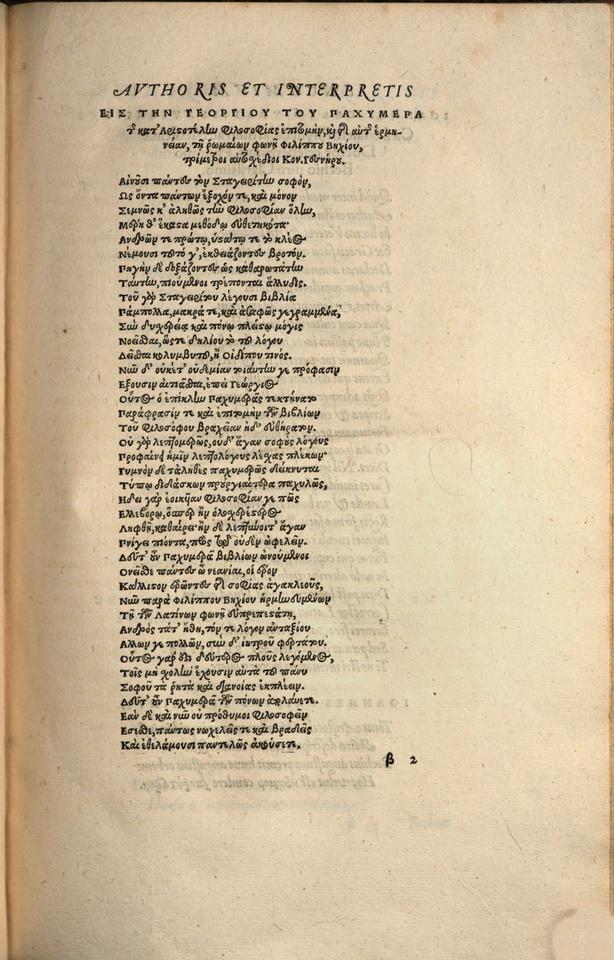
Conrad Gessner, Poem. In: Georgius Pachymeres, In Vniversam Fere Aristotelis Philosophiam, Epitome ... e Graeco in Latinum ... conuersa a Clariß. viro D. Philippo Bechio*.* Basel: Froben, 1560, printer mark ß2. Austrian National Library, signature: 71.N.1. .
VD 16 entry:
Georgius <Pachymeres>. *GEORGII PACHY-||MERII HIEROMNEMONIS, IN || VNIVERSAM FERE ARISTOTELIS PHILOSOPHIAM, EPITO-||me ... || è Graeco in Latinũ sermo-||nem nunc primùm ... conuersa, à ... D.PHI-||LIPPO BECHIO, Philosopho, Medico, at#\[que\] inclytae Aca-||demiae Basiliensis professore Dialectico ordinario.|| SVBIVNCTVS EST HVIC PERIPATETICO, PHILOSOPHVS || Platonicus, Synesius Cyrenaeus,per Ianum Cornarium Medicũ, Physicum, nunc || primùm Latinus factus ... ||*. BASILEAE, M.D.LX.||(PER || HIER.FROBENIVM ET NIC.EPISCOPIVM,|| MENSE SEPTEMBRI ... ||). Basel: Froben, Hieronymus d.Ä. und Episcopius, Nik. d.Ä., 1560.
\#Basel #Aristotle #Fries