
Ruf (Zurich, 1554)
Author of this page: Elena Lu, Harvard (2024)
Introduction:
Translation:
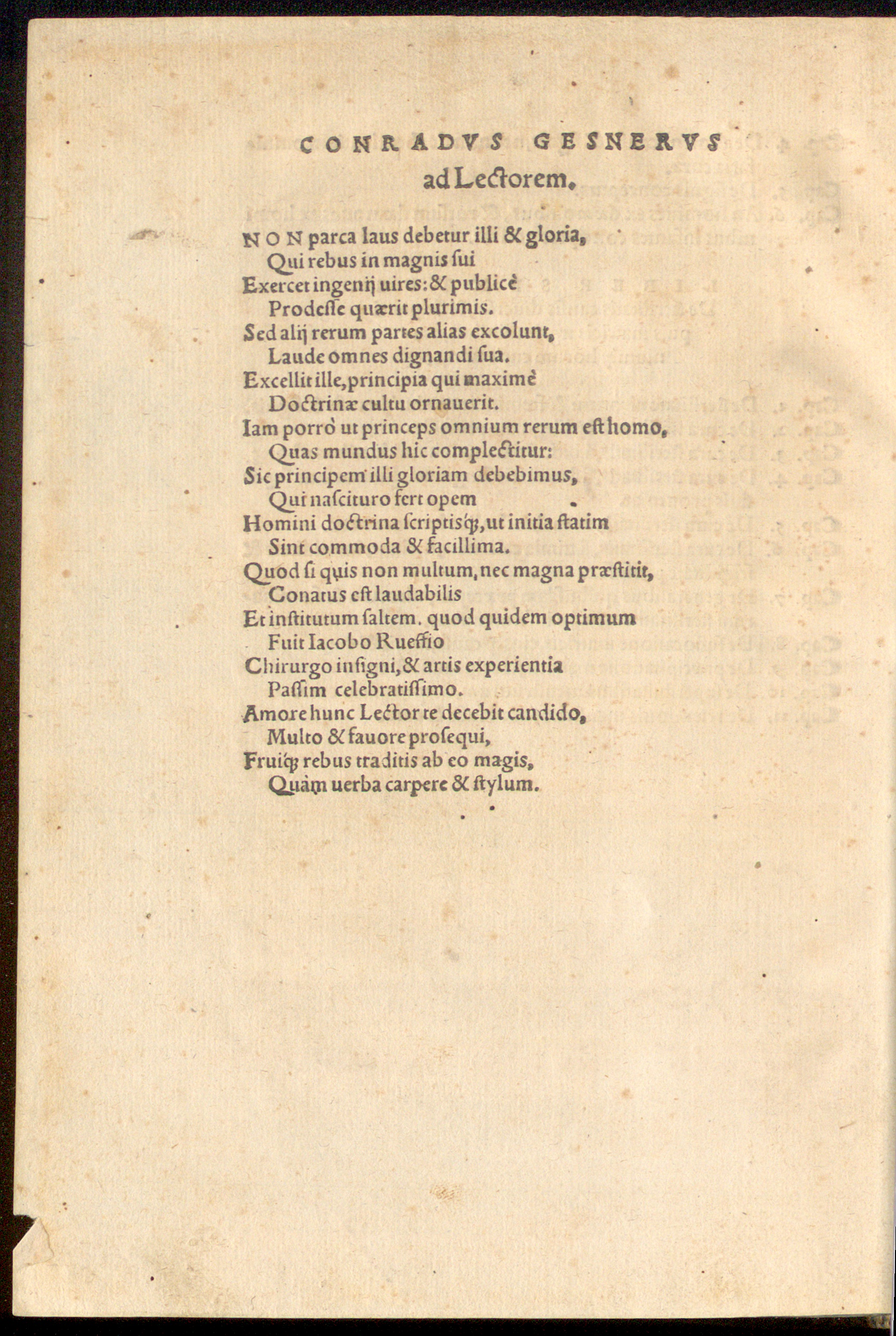
Conrad Gessner to the Reader.
No small praise or glory is owed to the man who uses the might of his genius to great advantage: in public affairs too, he aims to help as many as possible. But some refine some aspects of affairs, and others refine others; all should be honored with his own praise. He who best furnishes his beginnings with the cultivation of knowledge is a distinguished man.
But now, just as mankind is foremost in everything encompassed in the world: thus we will owe the foremost glory to he who through learning and reading describes the might of a man who will later be born, so that that man’s early days should be perfect and simple from the start. Since, if a man distinguishes himself neither by much nor in great matters, he nonetheless makes an admirable effort, at any rate, at his intentions.
This indeed has been best for Jacob Ruf—the distinguished surgeon, widely celebrated in the endeavor of practice—it will befit you, Reader, to follow this man with clear love and much favor, and to reap from him the knowledge he has received, rather than pluck at his words and his style.
Transliteration:
Conradus Gesnerus ad Lectorem
Non parca laus debetur illi et gloria,
Qui rebus in magnis sui
Exercet ingenii vires : et publicè
Prodesse quaerit plurimis.
Sed alii rerum partes alias excolunt,
Laude omnes dignandi sua.
Excellit ille, principia qui maximè
Doctrinae cultu ornauerit.
Iam porrò ut principes omnium rerum est homo,
Quas mundus hic complectitur :
Sic principem illi gloriam debebimus,
Qui nascituro fert opem
Homini doctrina scriptisque, ut initia statim
Sint commoda et facillima.
Quod si quis non multum, nec magna praestitit,
Conatus est laudabilis
Et institutum saltem. Quod quidem optimum
Fuit Iacobo Rueffio
Chirurgo insigni, et artis experientia
Passim celebratissimo
Amore hunc Lector te decebit candido,
Multo et fauore prosequi,
Fruique rebus traditis ab eo magis,
Quam uerba carpere et stylum.
Citation:
Conrad Gessner, Poem, in Jacob Ruf, De conceptu et generatione hominis, et iis quae circa hec potissimum consyderantur libri sex. Zurich: Froschauer, 1554, sig. [αα4v].
Zentral- & Hochschulbibliothek Luzern, Link: https://doi.org/10.3931/e-rara-97443